Showing posts with label Dyslexia. Show all posts

Friday, September 7, 2012

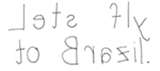
REVERSALS - Letter & Number

(a white paper from the College of Optometrists in Vision Development - www.COVD.org)
 

Problems of letter and number reversals in children have concerned parents and educators for many years.  Some have considered reversals as a symptom of dyslexia.  More commonly reversals reflect a lag in spatial development.

Most research has shown there is no structural or medical basis for these reversals.  Although reversals are common and expected in five to six year old children, they may persist through childhood.  Some adults may even continue to manifest these problems.


For many years, scientists have studied children with reversal problems, particularly regarding orientation to right and left as related to their own bodies (laterality), and to objects around them (directionality).

At three, or even younger, the child should have grasped the concept of top and bottom, and right side up or upside down (even though still looking at books upside down).

The four year old is grappling with front and back, and may still put a shirt on backward.  Many four year olds show reversals as they put on shoes by themselves.  Some four to five year olds may start printing numbers and letters from right to left. At these ages, this is a normal stage of developing orientation in children.

Although most children master this concept of directionality by age seven, this confusion in orientation may continue, in some people, all their life. Reversals are a manifestation of a developmental lag in the process of orientation. They are indicative of an underlying problem in the integration of the vestibular and visual systems in the brain.

Rote repetition of learning to write letters and numbers correctly or rotely learning right and left hands may help us pass a test, but it does not solve the problem of the underlying causative factor of delayed orientation development.

The development of orientation starts in the prenatal period with the attitudinal reflexes which help the fetus orient in utero. This development continues through varied learned experiences in our lives. Interferences in movement activities involving vision and neuromotor relationships limit the development of orientation.

According to the neuroscientist J.D. French, orientation contributes in an important way to the highest mental processes--the focusing of attention, and the ability to think, to learn, and to act.

Specific vision therapy, including the unique application of lenses and prisms during visual-neuromotor activities (movement with awareness and feedback), provides learning experiences to improve the development of laterality, directionality and orientation, and the related problems of reversals.

When a child learns to orient easily, the evidence points to a well integrated and effectively operating person.

--James B. Mayer, OD, FCOVD
     Agape Learning & Optometry Center
     Thousand Oaks, CA

Thursday, August 30, 2012

Tech Use Taking Toll On Kids' Eyes

 Tech Use Taking Toll On Kids' Eyes

Doctor: School vision exams don't catch everything


AUSTIN (KXAN.com) - One-in-four school-aged children have vision problems that can affect learning. But often, children and parents don't have a clue there's anything wrong.
Between buying school supplies, school lunches and new clothes, parents have their hands full getting kids ready to head back to class.

But there's one more thing that can start them off on the right foot.

"It's really imperative that all children receive a comprehensive vision exam before they start school," said Dr. Mary McMains.

McMains says school vision screenings only detect about 5 percent of problems and often miss identifying children who have trouble seeing up close.

The National Eye Institute also reports longer stints in front of the computer screen are leading to more eye problems at an earlier age.

"What we're seeing is that we're having more nearsightedness, more complaints of double vision, blurry vision, tired eyes, headaches," McMains said.

When Kirby Youngblood first came to her office, the third grader was experiencing several headaches a day and his school work was suffering.

"You can see there's colored letters that are thicker, erase marks -- I didn't erase very well," Kirby Youngblood said.

After eight months of special vision therapy catered to kids that often looks more like an arcade than a doctor's office, his vision has improved.

"It's like watching your child transition into someone new -- someone you always knew that they were, but something was holding them back," said Sheila Youngblood.

Because most kids don't know there's a problem, there are warning signs to look for.

"Rubbing the eyes, watery red eyes can be a factor or if you notice a child is taking their book and holding it too close and pushing it far away, squinting, turning their heads so that their nose might be blocking one eye because they're having difficulty coordinating both eyes on the page," McCains said.

A good rule of thumb is to be proactive rather than reactive.
Doctors recommend a child's first eye exam be done before they turn age one, then again at age three and another right before schools starts.

Wednesday, August 3, 2011

Letter & Number Reversals - Dyslexia? (COVD White Paper)

Problems of letter and number reversals in children have concerned parents and educators for many years.  Some have considered reversals as a symptom of dyslexia.  More commonly reversals reflect a lag in spatial development. Most research has shown there is no structural or medical basis for these reversals. Although reversals are common and expected in five to six year old children, they may persist through childhood.  Some adults may even continue to manifest these problems.

For many years, scientists have studied children with reversal problems, particularly regarding orientation to right and left as related to their own bodies (laterality), and to objects around them (directionality). At three, or even younger, the child should have grasped the concept of top and bottom, and right side up or upside down (even though still looking at books upside down). The four year old is grappling with front and back, and may still put a shirt on backward.  Many four year olds show reversals as they put on shoes by themselves.  Some four to five year olds may start printing numbers and letters from right to left.  At these ages, this is a normal stage of developing orientation in children.

Although most children master this concept of directionality by age seven, this confusion in orientation may continue, in some people, all their life.  Reversals are a manifestation of a developmental lag in the process of orientation.  They are indicative of an underlying problem in the integration of the vestibular and visual systems in the brain.  Rote repetition of learning to write letters and numbers correctly or rotely learning right and left hands may help us pass a test, but it does not solve the problem of the underlying causative factor of delayed orientation development.

The development of orientation starts in the prenatal period with the attitudinal reflexes which help the fetus orient in utero.  This development continues through varied learned experiences in our lives.  Interferences in movement activities involving vision and neuromotor relationships limit the development of orientation. According to the neuroscientist J.D. French, orientation contributes in an important way to the highest mental processes--the focusing of attention, and the ability to think, to learn, and to act.

Specific optometric vision therapy, including the unique application of lenses and prisms during visual-neuromotor activities (movement with awareness and feedback), provides learning experiences to improve the development of laterality, directionality and orientation, and the related problems of reversals.  When a child learns to orient easily, the evidence points to a well integrated and effectively operating person.

Members of the College of Optometrists in Vision Development (COVD) are optometrists who have demonstrated interest in the problems and remediation of reversals. Fellows of the College are certified in the diagnosis and treatment of learning related vision problems. For further information, contact COVD or consult with a COVD member optometrist.

This informational paper was produced by the College of Optometrists in Vision Development, which board certifies qualified optometric physicians in vision therapy. For further information, see our website, www.covd.org. WP5 Rev 1/2/08 ©2008

--James B. Mayer, OD, FCOVD
     Agape Learning & Optometry Center
     Thousand Oaks, CA