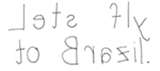
Problems of letter and number reversals in children have concerned parents and educators for many years. Some have considered reversals as a symptom of dyslexia. More commonly reversals reflect a lag in spatial development. Most research has shown there is no structural or medical basis for these reversals. Although reversals are common and expected in five to six year old children, they may persist through childhood. Some adults may even continue to manifest these problems.
For many years, scientists have studied children with reversal problems, particularly regarding orientation to right and left as related to their own bodies (laterality), and to objects around them (directionality). At three, or even younger, the child should have grasped the concept of top and bottom, and right side up or upside down (even though still looking at books upside down). The four year old is grappling with front and back, and may still put a shirt on backward. Many four year olds show reversals as they put on shoes by themselves. Some four to five year olds may start printing numbers and letters from right to left. At these ages, this is a normal stage of developing orientation in children.

Although most children master this concept of directionality by age seven, this confusion in orientation may continue, in some people, all their life. Reversals are a manifestation of a developmental lag in the process of orientation. They are indicative of an underlying problem in the integration of the vestibular and visual systems in the brain. Rote repetition of learning to write letters and numbers correctly or rotely learning right and left hands may help us pass a test, but it does not solve the problem of the underlying causative factor of delayed orientation development.
The development of orientation starts in the prenatal period with the attitudinal reflexes which help the fetus orient in utero. This development continues through varied learned experiences in our lives. Interferences in movement activities involving vision and neuromotor relationships limit the development of orientation. According to the neuroscientist J.D. French, orientation contributes in an important way to the highest mental processes--the focusing of attention, and the ability to think, to learn, and to act.
Specific optometric vision therapy, including the unique application of lenses and prisms during visual-neuromotor activities (movement with awareness and feedback), provides learning experiences to improve the development of laterality, directionality and orientation, and the related problems of reversals. When a child learns to orient easily, the evidence points to a well integrated and effectively operating person.
Members of the College of Optometrists in Vision Development (COVD) are optometrists who have demonstrated interest in the problems and remediation of reversals. Fellows of the College are certified in the diagnosis and treatment of learning related vision problems. For further information, contact COVD or consult with a COVD member optometrist.
This informational paper was produced by the College of Optometrists in Vision Development, which board certifies qualified optometric physicians in vision therapy. For further information, see our website, www.covd.org. WP5 Rev 1/2/08 ©2008
--James B. Mayer, OD, FCOVD
Agape Learning & Optometry Center
Thousand Oaks, CA